
Website Security: Protecting Your Customers’ Data
Attacks keep getting more sophisticated. Make sure your business application and website carry the security layers that keep trust intact.

Tim InvictusWave
Staff Software Architect
Summary
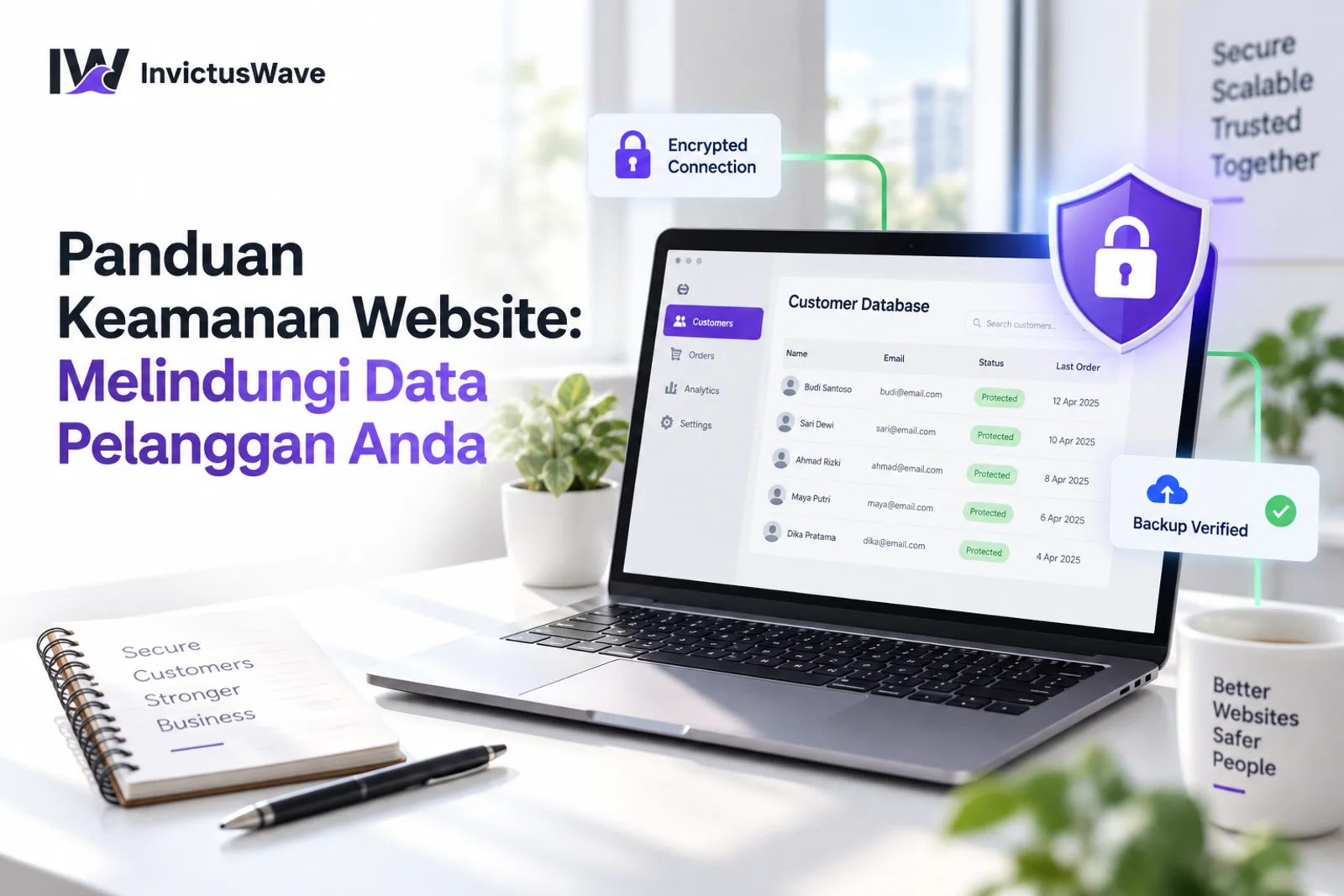
Website security starts with routine updates, restricted access, and a way to recover when something goes wrong.
Treat this as a piece of work to be solved, not a feature list to buy outright. Start from the effect on your customers and your team. If a problem makes prospective customers hesitate, produces the same question over and over, or slows daily work, it deserves priority. A change that merely looks appealing without altering the main process can wait.
Decisions do not have to be perfect from the start. What matters is that each one has a reason, a measure of success, and a date to be looked at again. That is what lets a team move without locking itself into a plan that turns out not to fit reality.
What to check
Use strong passwords, additional authentication where available, backups, HTTPS, and up-to-date dependencies and servers.
Do the checking from the user's point of view. Try to complete the main task from a phone on an ordinary connection, without inside knowledge of the business or the system. Note where information is hard to find, where the wording is unclear, or where a user has to ask before they can continue. Simple findings like these are often more useful than assumptions from inside the team.
Check the operational side too. Establish where the data comes from, who updates it, and what happens when something goes wrong. A page or a system that looks fine at launch becomes a problem when nobody owns the content, nothing records what changed, and there is no recovery procedure.
Setting priorities
Use three questions to order the work. Does this change help users complete what they came to do? Does it reduce manual work, errors, or repeated questions? Can the result be seen in data or user feedback? Work that answers the most of those generally goes first.
Separate what is required, what is important, and what can wait. The required keeps the main flow running. The important improves the experience once that flow is proven. Ideas that can wait stay on the list, but must not hold up a launch and an early review.
How to apply it
- 1Record the current state and the problems users or the team hit most often.
- 2Pick the single change with the largest effect, then decide who owns it.
- 3Test that change against a real flow before adding any other feature or work.
- 4Compare the result over a like-for-like period. For a website, measure contact clicks, valid form submissions, and mobile issues. For an internal system, measure time taken, error counts, and steps you can remove.
- 5Review the result with the people who actually use the process. If the change does not help, fix it or roll it back before moving on.
Technical notes
Base decisions on usage data, error reports, or customer questions. Keep a record of each change and the reasoning behind it so the team can review the outcome later.
For a website, the basic data comes from Search Console, analytics, error logs, and forms. Watch for pages that get impressions but few visits, pages that get opened often but produce no action, and the devices people actually use. For an application or an internal system, look at error logs, response times, support tickets, and the parts of the process that get redone most.
Do not let a single number stand as the only evidence. More visits does not necessarily mean a user need was met. Pair the numbers with feedback from customers or operators so the context stays clear.
A worked example
Pick one page, flow, or process as a trial. Record the state before the change: time taken, incoming questions, form failures, or the step people abandon most. Apply one improvement, then compare over a like-for-like period. If the result is unclear, check error reports, customer feedback, and the devices in use before adding another change.
For instance, when a page draws the same question over and over on WhatsApp, do not reach straight for a chatbot or a longer form. Check first whether a clearer heading, a starting price, an example of the work, or a plainer explanation of the process would answer it. Fixing the information is usually easier to maintain than building a new feature.
For a small team, a weekly note is enough. Write down what changed, why that option was chosen, what the result looked like, and what comes next. A short document like that helps new members understand the context and stops old problems repeating.
Risks worth avoiding
Do not change design, content, and technology all at once — the result becomes impossible to read. Avoid collecting data nobody uses to make a decision. Make sure every new form, integration, or access route has an owner responsible for checking and updating it. If a change touches transactions, customer data, or account access, test the failure path and the recovery before it goes live.
What comes next
Decide who receives security alerts and how often the backups are actually test-restored.
Basic security checklist
| Area | Minimum practice |
|---|---|
| Access | Unique passwords and additional authentication |
| Recovery | Backups that have actually been tested |
| Updates | Dependencies and servers kept current |
An untested backup is not a backup+
A backup only helps when the team knows how to restore it and has practised the process somewhere safe.
Related Tags
Tim InvictusWave
Staff Software Architect
Specializing in high-performance web systems, modern stack modernization, and AI workflow integrations accelerating scalable digital products at InvictusWave.
Facing a Similar Architecture Challenge?
Schedule a technical exploration session with our lead architects to discuss performance audits or system modernization.